How to Become an Auto Locksmith in the UK
Auto locksmithing combines mechanical lock work, key cutting, electronics, immobiliser programming, diagnostics and customer-facing mobile service. Learning only one of those areas is not enough for a broad modern vehicle service.
There is no shortcut that turns a programmer purchase into competence. A safer route is structured training, supervised practice, controlled expansion into vehicle systems and a business plan that budgets for equipment, stock, insurance and continuous learning.
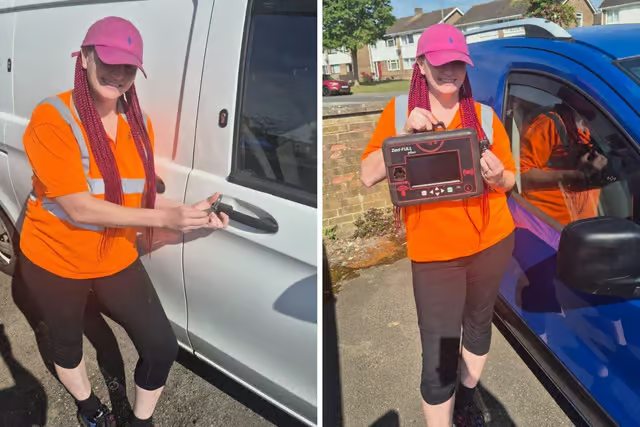
What is the best route into auto locksmithing?
Learn the fundamentals first: vehicle-entry principles, key identification and cutting, transponders, remotes, immobilisers and safe diagnostic practice. Use reputable training and practical supervision, then expand into more advanced systems only as your competence and equipment support grow. The National Careers Service lists professional-body training as one route into locksmithing, and the Master Locksmiths Association runs dedicated auto-locksmith courses.
Understand what an auto locksmith actually does
A modern automotive locksmith is not simply a person who cuts car keys. Daily work can include non-destructive vehicle entry, replacement and spare keys, all-keys-lost jobs, transponder programming, remote and smart-key work, broken-key repair, immobiliser diagnosis and, for supported vehicles, steering-lock or module procedures.
The mix changes by business. Some locksmiths focus on older mechanical vehicles; others specialise in particular brands, EEPROM/module work or commercial fleets. Before choosing training or tools, decide what service you eventually want to provide. A narrow but competent service is safer than advertising every make and fault after a short course.
AutoKeyChase’s current service structure shows the breadth: replacement keys, lost keys, spare keys, vehicle unlocking, programming, broken-key work, steering-lock faults and immobiliser diagnostics. A trainee should understand where each service begins and ends.
Learn mechanical entry and key fundamentals before advanced programming
Electronics receive most of the attention in modern auto locksmith marketing, but mechanical knowledge still matters. You need to understand lock operation, key profiles, wear, decoding/cutting principles and how to gain vehicle access without causing unnecessary damage. A programmer cannot help if the key blade is wrong or you cannot safely access an all-keys-lost vehicle.
Practice should happen in controlled, authorised environments. Vehicle-entry techniques are security-sensitive and can damage airbags, wiring, glass or trim when used without understanding the specific vehicle. Training equipment, cutaway locks and supervised vehicles are better learning tools than experimenting on customer cars.
Build a habit of entitlement checks from the beginning. The technical ability to create or use a key is inseparable from the responsibility to confirm that the customer is authorised to request the work.
Learn the difference between transponder, remote and smart-key systems
A transponder is the electronic identifier used by the immobiliser. A remote can add central-locking functions, while a smart or proximity key can allow passive entry and push-button start. These functions can be combined in one physical fob but may use different procedures.
That distinction helps you diagnose complaints. “The buttons do not work” is different from “the engine will not authorise starting”. A key can sometimes start while the remote is dead, or lock/unlock while an immobiliser problem prevents starting. Treating every symptom as a programming job is poor diagnosis.
Learn how manufacturers evolve systems over model generations. Volkswagen Group, BMW, Mercedes-Benz, Ford, Volvo and Nissan all have different histories of immobilisers and key platforms. Brand pages and manufacturer documentation are useful for building a structured vehicle knowledge base.
Choose structured training and realistic practical exposure
The National Careers Service lists applying directly and training with a professional body as routes into locksmithing. The Master Locksmiths Association offers locksmith training and dedicated auto-locksmith courses. Those sources are useful starting points because they are clear about training as a process rather than a promise of instant high income.
AutoKeyChase also provides advanced auto locksmith training. Whatever training route you use, evaluate it by practical content, instructor experience, safety, vehicle coverage and what you can realistically do after the course—not by claims about guaranteed earnings.
Build your toolset around supported work, not brand names on a shopping list
Beginners often ask which one programmer they should buy. The answer is that no single platform is strongest on every vehicle or procedure. AutoKeyChase uses Zed-Full Plus, Smart Pro, Autel, ACDP, VVDI Prog, VVDI2, VVDI MB, Key Tool Plus, OSCA, R-Link, Tango, Lonsdor and KDX4 because different tools cover different security systems and tasks.
That does not mean a new locksmith needs to buy all of them on day one. Start with the work you are trained to perform and the vehicle population you expect to see. Understand ongoing token, subscription, update and adapter costs before committing to hardware.
Also budget for cutters, stock, batteries, diagnostic support, a reliable laptop or tablet, internet/data, chargers, vehicle power support and safe storage. The true start-up cost is the working system around the programmer, not the programmer alone.
Learn diagnostics so you do not replace keys for vehicle faults
One of the most expensive beginner mistakes is treating every no-start or “key not detected” complaint as a bad key. A weak vehicle battery, antenna fault, immobiliser problem, steering lock, wiring issue or damaged module can produce similar symptoms.
Use known-good keys where available, read fault information appropriately and observe vehicle behaviour before deciding that a replacement key is the solution. Knowing when to stop is a technical skill. If the procedure moves beyond your equipment or knowledge, refer or subcontract rather than experimenting on a customer module.
This is also why advanced training has value: it builds fault-finding habits and system understanding rather than teaching only button sequences on a programmer.
Treat proof of entitlement, insurance and records as part of the trade
Automotive key work gives direct access to vehicles, so customer verification should be normal business procedure. Decide what evidence you require for different job types and how you record the job without collecting more personal data than necessary.
Business insurance should match the work you actually perform. Public liability, professional/indemnity considerations, vehicle insurance, tools and stock all need discussion with an appropriate insurer. Do not copy another locksmith’s claimed cover amount onto your website or assume a standard policy automatically covers module programming or customer vehicles.
Keep job notes, quotes and payment records consistently. Good administration protects both the customer and the business when a vehicle has pre-existing faults or a job changes after diagnosis.
Build trust and customer acquisition alongside technical skill
Self-employment means you also need customers. A clear website, Google Business Profile, genuine reviews, professional phone handling and evidence of real work can be as important commercially as another tool. Customers are making a trust decision before they hand over a vehicle or agree to programming.
Avoid creating dozens of fake offices or copied city pages. A mobile service can rank and convert with an honest base, genuine service areas and useful location pages. AutoKeyChase’s structure keeps one real Corby base while explaining mobile coverage around Kettering, Wellingborough, Northampton and nearby villages.
Publish real job examples only when you know the facts. Do not invent models, prices, locations or time taken for a photograph just to make the marketing stronger. Long-term trust is worth more than a dramatic case study that cannot be verified.
Progress in stages instead of trying to cover every vehicle immediately
A practical progression could start with controlled entry, basic cutting and supported spare/replacement keys, then expand into all-keys-lost, more complex smart-key systems, brand-specific platforms and deeper diagnostics. The exact order depends on your training and equipment, but the principle is to add risk gradually.
Track which jobs you decline and why. If you repeatedly turn away a certain manufacturer because of one missing capability, that can justify the next training or equipment investment. Buying tools because another locksmith owns them is a poor investment strategy.
Keep learning. Vehicle security changes continuously, including digital keys and new anti-theft systems. Thatcham Research’s security technology work is one example of how fast the vehicle-access landscape is moving.
Related AutoKeyChase Guides & Services
Automotive Locksmith Experience Behind the Advice
AutoKeyChase is a family-run automotive locksmith business founded by Hannah and John Middleton in 2018. Hannah grew up around locksmithing through her father and works hands-on with vehicle keys, immobilisers, programming systems and mobile automotive locksmith jobs.
The business is based in Corby and provides mobile coverage across surrounding Northamptonshire areas. AutoKeyChase is DBS checked and fully insured, and uses professional equipment including Zed-Full Plus, Smart Pro, Autel, ACDP, VVDI platforms, Key Tool Plus, Tango and Lonsdor.
This article is educational rather than a substitute for inspecting a specific vehicle. Where a statement depends on the manufacturer, key system or fault, the guide says so rather than pretending one procedure applies to every car.
How to Become an Auto Locksmith in the UK – FAQs
Do I need a licence to become an auto locksmith in the UK?
How long does it take to learn auto locksmithing?
What tools does an auto locksmith need?
Can I start with one key programmer?
Is there demand for auto locksmiths?
What AutoKeyChase Customers Say
Live Google review content provides independent customer evidence alongside our technical guides.
EXCELLENT Based on 21 reviews
 Posted on Google
 Karen FaulknerSo impressed with this company today .I'd tried everywhere to get an auto lock smith out couldn't get one then this company was recommended.. excellent service ..so helpful..friendly would recommend mend to anyone needing a car keys ...can't praise them enough .thanks so muchPosted on Google
 Charlotte-Emily GayneAbsolutely lovely lady who helped my aunt out when Timpsons lost the transponder on her car key, she was so quick, gave us excellent customer service and went above and beyond to get my aunt on her way, I would recommend her to anyone that needs their key sorting out!!Posted on Google
 Naomi GibbonsAbsolutely brilliant service, she was quick, informative and went above and beyond to ensure my car key problem was sorted , fantastic servicePosted on Google
 David SmithGreat service and very helpful. I would highly recommend.Posted on Google
 Oke OladimejiHelpful. Brilliant and very very hardworking! Thank you for coming right away after calling and helping me replace my car keys. Highly recommended!Posted on Google
 Lee TURNERLiterally first class service. After a nightmare leaving key in car, Hannah went out way to test the key and check for any problems or fault with it. Got the key working for now and gave advice to replace soon. Definitely a life saverPosted on Google
 garcia GarciaShe is a genuine person,I was really impressed,I had problem with the ignition barrel ,she came and fixed it .she is really good honestlyPosted on Google
 Lewis PucillTurned up, cut and programmed 2 keys both working faultlessly within 2 hours. Spot in service!Posted on Google
 emma hicksReally helpful and explained everything clearly. Came out early in the morning. Quickly gained access to the vehicle and sorted the problem. Thanks so muchPosted on Google
 Sam ShirleyHonest, decent and really helpful. The car has been left in perfect condition, the key is flawless. Attended at a weekend and time that suited me. I cannot rate highly enough. Extremely genuine lady and affordable against the rest of the quotes.
Talk to AutoKeyChase
Send the vehicle registration, make, model, year, your location, whether a working key remains and what has happened. We can identify the likely service route and current mobile availability.